
More and more homeowners in Las Vegas, Nevada, are considering clean energy by investing in solar panels. If you’re planning to install some, you might wonder, “How are solar panels installed? Are they going to take one day or a month?”
The short answer is that it’s a multi-phase project, not a one-day job. Solar installation is a project with distinct phases. Each step of the solar process can take more than a day to complete. Depending on the complexity of your roof, it can take a few days. This article will guide you through the entire solar panel installation process so you know exactly what to expect.
Phase 1: Planning and Preparation (Before the Installation Day)
This first stage sets the foundation for your solar energy system. It also helps in managing the timelines.
1Consultation and Site Assessment
The journey starts with a one-on-one, face-to-face consultation and property assessment. A solar expert will evaluate your home and do the following:
- Evaluate your home’s current energy usage.
- Inspect the condition of your roof.
Crucial Step: Analyze its orientation and sun exposure. This is to determine if your roof has enough space and sufficient sunlight to make it a good candidate for solar panels. It also ensures optimal energy production, as explained by the U.S. Energy Information Administration.
2System Design and Proposal
After a thorough assessment, the engineers will:
- Create a custom system design tailored to your home’s energy needs.
- Factor in your roof size and local building codes to determine the optimal number and placement of panels
- Receive a detailed proposal outlining the solar system layout, projected energy production, and a clear breakdown of costs.
The design focuses on maximizing the amount of electricity your panels can generate.
3Getting Permits and Approvals
This is a crucial step. But somehow, many homeowners feel like it’s a waiting game. Why?
In this stage, the solar company will process all required permits with the local government in Las Vegas, Nevada. They’ll submit all applications to the utility company.
The process is vital to ensure that your solar installation complies with all regulations.
Phase 2: The Main Event (Installation Day)
Once all permissions are in place, the solar experts will start to work. It’s when the physical installation of your solar panel takes place.
4Roof Preparation and Racking Installation
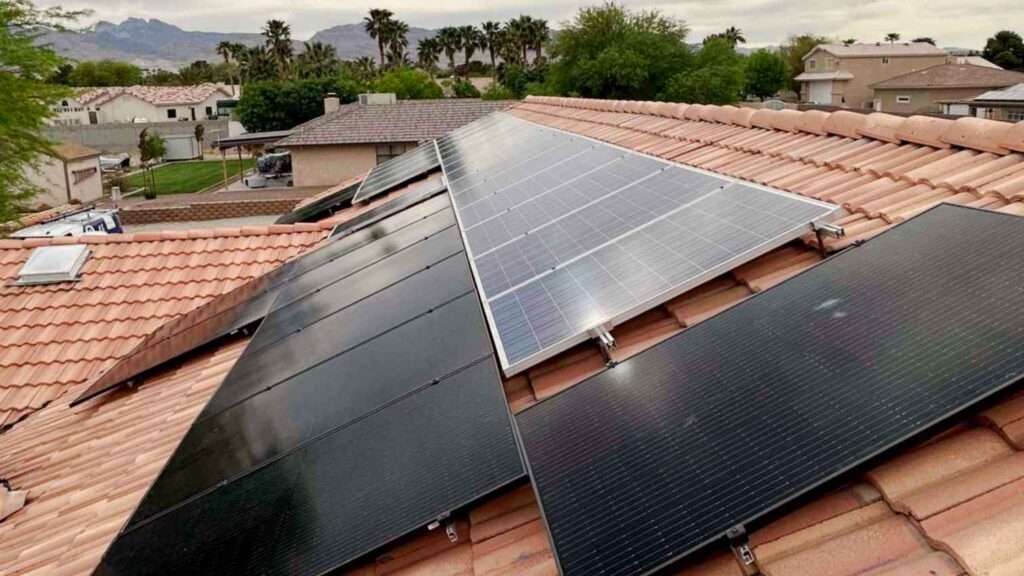
Bob’s Repair certified installers will start to secure stanchions (mounts) directly to your roof rafters. On top of these mounts, a racking system is attached that will securely hold your solar panels.
Important: We only use industry-leading sealants to ensure a watertight and durable installation, protecting your roof for years to come.
5Installing the Panels and Inverter
- The solar panels are carefully and securely mounted onto the racking system. These panels are made from semiconductors, usually silicon, that release electrons when exposed to sunlight, generating direct current (DC) electricity.
- An inverter is also installed during this step. It’s the brain of the system that’s installed in a garage or an exterior wall. It converts the DC electricity from the panels into alternating current (AC) electricity that your home can use.
6Wiring and System Connection
The installers will run the conduit and wiring to connect the panels to the inverter and the inverter to your home’s main electrical panel. It ensures that the electricity generated by your solar system can be safely and efficiently integrated into your home’s electrical system.
Phase 3: Activation (After Installation)
The physical installation is complete. But there are other critical steps before your solar system is fully operational and generating clean energy.
7Final Inspections
Once the installation is complete, the entire system is inspected and approved by the local city or county building department. This inspection confirms that the installation meets all safety and building codes. It ensures your system is up to standard.
8Getting Permission to Operate (PTO)
After the inspection passes, the utility company will permit you to use the panels to generate electricity. This official authorization is called Permission to Operate (PTO).
Important: Before operating the system, it’s vital to understand that your system must not be turned on until this PTO is granted. Once you receive it, your solar panels are ready to start generating clean, renewable energy for your home. The utility company will also install a net meter to measure the amount of energy you generate and feed back into the grid if you have a grid-tied system.
The Complete Solar Installation Process at a Glance
For a clear overview of the entire solar panel installation journey, here is a breakdown of all eight steps across the three key phases.
Phase 1: Planning and Preparation (Before Installation Day)
Consultation and Site Assessment
Evaluate your home’s energy usage, roof condition, orientation, and sun exposure to determine suitability for solar.
System Design and Proposal
Create a custom solar system design based on energy needs and roof size, then provide a detailed proposal.
Getting Permits and Approvals
Process all necessary permits with the local government and utility company to ensure compliance.
Phase 2: The Main Event (Installation Day)
Roof Preparation and Racking Installation
Secure mounts to your roof rafters and attach the racking system using watertight sealants.
Installing the Panels and Inverter
Mount solar panels, which convert sunlight into DC electricity, and install the inverter, which converts DC to AC.
Wiring and System Connection
Run conduit and wiring to connect the panels to the inverter and the inverter to your home’s electrical panel.
Phase 3: Activation (After Installation)
Final Inspections
The completed system undergoes inspection and approval by the local building department.
Getting Permission to Operate (PTO)
Receive official authorization from the utility company to turn on and operate your solar system.
Ready to Install Solar Panels?
If you think you can benefit from a solar system, your next step is to obtain a free, no-obligation consultation from our experts. Serving Anthem, North Las Vegas, Henderson, and the greater Las Vegas area, Bob’s Repair is ready to help you on your journey to clean energy.
Give us a call today to schedule your consultation!

