
You know the drill. You wake up, step outside, and everything is coated in a fine, tan layer of grit. The wind howled all night, visibility dropped to nothing, and the local news is running footage of fallen power poles along Tropicana Avenue and Eastern Avenue. Another haboob rolled through the Las Vegas Valley.
While you’re sweeping off your patio, your solar panels are sitting on the roof beneath that same layer of silt. And unlike your driveway, they can’t just be hosed off without consequences.
This is your guide for the morning after. What actually happened to your system, what you should check right now, and the one cleanup mistake that causes more long-term damage than the dust storm itself.
Dust Storm Las Vegas Homeowners Can’t Afford to Ignore
Dust storms are a recurring feature of life in the Las Vegas Valley, not freak events. They roll through every monsoon season, roughly late June through September, when the North American Monsoon pumps unstable air over the superheated desert floor.
These storms form when collapsing thunderstorms send massive downdrafts of cold air slamming into the valley floor, scooping up sand and silt into a wall of dust thousands of feet tall. The National Weather Service will issue a Dust Storm Warning for areas like Clark County when one is actively occurring.
What a Las Vegas Windstorm Leaves Behind
Winds during these events regularly reach 50 to 70 mph. During the July 2025 monsoon event, gusts hit 70 mph across the valley, snapping over 50 power poles and leaving around 90,000 customers without electricity. Clark County officials reported downed power lines along Tropicana Avenue, Sahara Avenue, and Jones Boulevard. NV Energy had crews working around the clock to restore service.
The chaos extends beyond solar panels. These storms create dangerous driving conditions, knock trees into roadways, and trigger widespread power outages. The region’s shelters and resources get stretched thin as residents seek relief from the heat.
During an active monsoon season, the valley can get hit multiple times in a single week. Your solar panels aren’t facing a one-time risk. It’s a cycle.
How a Dust Storm in Las Vegas Wrecks Solar Production
A haboob hits your solar array twice, once with dust and once with wind, and each creates a different problem.
The Efficiency Chokehold (The Dust)
A powerful dust storm deposits a uniform layer of fine particulate matter across every panel’s glass surface. The solar industry calls this “soiling,” and it acts as a physical barrier between the sun and the silicon cells, blocking and scattering the light your panels need.
Research shows that a single severe dust storm can reduce solar panel efficiency by 10% to 20% overnight, with losses compounding to 30% or more if panels go uncleaned. Just 6 to 8 grams of silt per square meter is enough to drop output by over 26%. Separately, research from Stanford University confirms that dust accumulation can ultimately cut solar panel power by 40% to 50%.
There’s also the “mud-rain” problem. Sometimes the trailing edge of a monsoon cell drops scattered raindrops after the dust wall passes. What little rain reaches your panels mixes with heavy dust to form a thick slurry that bakes into cement under the next morning’s 110-degree sun. At that point, the wind won’t blow it off. It has to be physically removed.
Strong Winds, Downed Power Lines, and Solar Panel Wind Damage

At 50 to 70 mph, strong winds create serious aerodynamic stress on rooftop arrays. Wind forces its way into the gap between the roof and the panels, creating uplift that pulls on racking rails and the lag bolts anchored into your rafters.
Field data from the National Renewable Energy Laboratory shows that solar arrays frequently fail at wind speeds well below their rated maximums. The most common failures aren’t the panels themselves but the hardware holding them down. Improperly torqued clamps rotate out of the rail under vibrating loads, and plastic wire ties, made brittle by years of desert heat, snap and let high-voltage cables drop onto the abrasive roof surface.
Wind vibration also causes invisible micro-cracks in silicon cells that create hot spots and degrade output. Larger debris, like trees and loose material turned into projectiles by 70 mph gusts, can shatter tempered glass entirely. If you suspect structural or electrical damage after a storm, professional solar panel repair services should be your first call.
Your Post-Storm Checklist
Do not climb on your roof. After a high-wind event, there may be loose racking, exposed wiring, or damaged panels carrying live DC current.
Check Your Monitoring App.
= Heavy Soiling Signal
Compare today’s production to a recent clear-sky day. A smooth curve peaking 15% to 25% lower than normal signals heavy soiling. Sudden inverter error codes are a bigger concern. SolarEdge systems commonly throw Error Code 18x (Isolation Fault) after storms and may shut down entirely, while Enphase systems may show a solid red LED for a ground fault.
Never touch exposed solar wiring or attempt to climb on your roof after a high-wind event—DC current is always live when the sun is out.
Do a Visual Ground Inspection
Look up at the array for shifted panels, dangling wires, or visible cracks. Check for debris that may have struck the roof. Also check for signs of pigeons nesting under solar panels, as storm damage to critter guards can give birds a new way in.
Do Not Touch the Garden Hose
This is the step most people get wrong, and it’s where the real damage starts.
Why You Should Never Spray Your Panels With a Garden Hose
Las Vegas tap water comes from the Colorado River via Lake Mead, traveling through hundreds of miles of limestone and gypsum deposits. The Las Vegas Valley Water District reports hardness levels of 16 to 18 grains per gallon, classified as “extremely hard” and among the highest in the country.
A solar panel sitting in direct sunlight can reach 150 to 185 degrees Fahrenheit. When mineral-heavy water contacts that superheated glass, it flash-evaporates, and the calcium and magnesium precipitate directly onto the surface. Because glass is microscopically porous, those minerals chemically bond with the silica, forming permanent limescale that degrades efficiency far worse than the dust did.
Spraying 60-degree groundwater onto 150-degree tempered glass also creates thermal shock, which can fracture or shatter the covering and void your manufacturer’s warranty immediately. Major manufacturers like Canadian Solar and Q-Cells state that damage from improper cleaning voids the warranty.
DIY vs. Professional Solar Panel Cleaning in Southern Nevada
| DIY Homeowner | Bob’s Repair | |
|---|---|---|
| Timing | Mid-day weekend, highest thermal shock risk | Early morning or late evening, safe glass temps |
| Water | Municipal hard water via garden hose (16–18 GPG) | 100% deionized, spot-free water (0 TDS) |
| Safety | Ladder falls, roof damage, and electrocution risk | OSHA-compliant harnesses, insured operation |
| Diagnostics | Visual only, no fault detection | Racking torque, wiring, and inverter error codes |
| Warranty | High risk of voiding the manufacturer’s warranty | Fully compliant with all major manufacturers |
How Bob’s Repair Cleans Solar Panels After a Dust Storm
Professional technicians bypass the municipal water supply entirely, using mobile reverse osmosis and deionization systems that bring Total Dissolved Solids down to zero. DI water leaves no residue and actively lifts silt from the glass without warranty-voiding detergents.
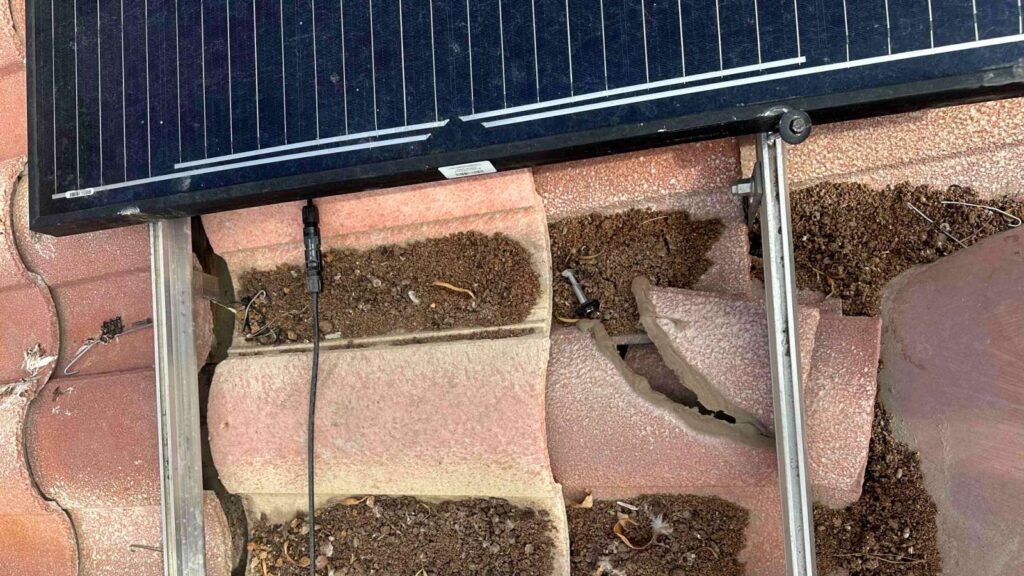
For baked-on desert silt, they use carbon-fiber water-fed poles with specialized brushes. Nylon monofilament heads handle routine dust, while boar’s hair brushes lift cemented post-storm buildup without scratching the anti-reflective coating.
The inspection matters more than the cleaning. Trained technicians check racking torque, verify wire management, and resolve inverter error codes. Window-washing companies don’t carry the tools to test ASCE 7-16 compliant roof mounts or diagnose SolarEdge isolation faults. Bob’s Repair does.
For homeowners weighing their options, here’s a breakdown of solar panel cleaning costs in Las Vegas to help you plan ahead.
Did your solar production drop after the latest dust storm? Don’t bake hard water onto your panels. Contact Bob’s Repair for a professional, spot-free solar cleaning and post-storm safety inspection.

