
Las Vegas is one of the sunniest cities in the U.S. With abundant sunshine, you can harness solar energy to help reduce your energy bills and decrease your environmental footprint. However, before you spend thousands of dollars on a solar system, you should ensure that your roof is solar-ready.
This article will provide you with a clear checklist of the five essential roof requirements for a successful solar panel installation.

1. Can Your Roof Handle the Weight? — Structural Integrity
Your roof is the foundation for your solar energy system. It must be capable of supporting the added weight. Solar panels and their mounting hardware, known as photovoltaic (PV) panels, can add a “dead load” to your roof. The additional load or weight of the PV system can range from 2 to 4 pounds per square foot, depending on the type of system, according to the International Code Council.
Beyond the PV panels, your roof must also withstand “live loads,” such as occasional high winds. This ensures that the solar arrays remain securely fastened.
Professional Assessment Required
That’s why a professional structural assessment is vital to double-check your roof’s health. The evaluation is performed by a roofing contractor or structural engineer. This is non-negotiable to ensure your roof trusses and overall structure can safely bear the additional weight of solar panels installed.
Meeting the requirements for solar is a standard part of the solar installation process with a reputable solar company. It helps identify any necessary repairs or reinforcements to ensure your roof’s long-term soundness.
2. Roof Condition and Age — The Most Common Hurdle

Golden rule for solar in Las Vegas: Solar Victoria states that a solar energy system is designed and warranted to last 25 years. Therefore, your existing roof must have at least 15-20 years of useful life left.
Imagine spending a significant amount of money just to remove newly installed solar panels to replace your aging roof prematurely.
Thus, when you evaluate your roof’s condition, look for the following signs:
- Missing, cracked, or curling roofing shingles
- Bare spots where granules have eroded
- Signs of leaks in your attic
Remember: The extreme weather and intense Las Vegas sun can accelerate the aging of roofing materials like asphalt shingles.
What can Bob’s Repair experts do?
- Provide an honest, unbiased roof inspection and evaluation.
- Offer an all-in-one solution for roof repair or roof replacement if the roof isn’t ready for solar.
The integrated approach can save you time, money, and the headache of coordinating multiple contractors just to get a new roof that’s structurally sound.
3. What’s Your Roof Made Of? — Roof Material
Most roofs are compatible with solar panels and their mounting equipment. The specific mounting systems and installation process can vary.
- Asphalt Shingles: They’re common in Las Vegas and straightforward for roof-mounted solar panels. They can be an ideal roof for solar mount panels.
- Concrete or Clay Tile: Tile roofs are widely seen on Las Vegas homes. They’re also suitable for solar.
- But they require specialized equipment, like tile hooks or comp-out sections. This is to ensure a watertight seal and prevent cracking during the solar installation.
- This is why you need to hire a reputable company that has a team of experts in roofing and solar.
- Metal Roofs: They’re excellent candidates for solar. Metal roofs can accommodate non-penetrating clamps, thereby reducing the need for roof penetrations.
- Flat Roofs: Although they’re not sloped like traditional residential roofs, they’re also great candidates. They typically utilize ballasted or tilted racking systems to ensure optimal energy production.
4. Available Space and Shading — Your Solar Real Estate
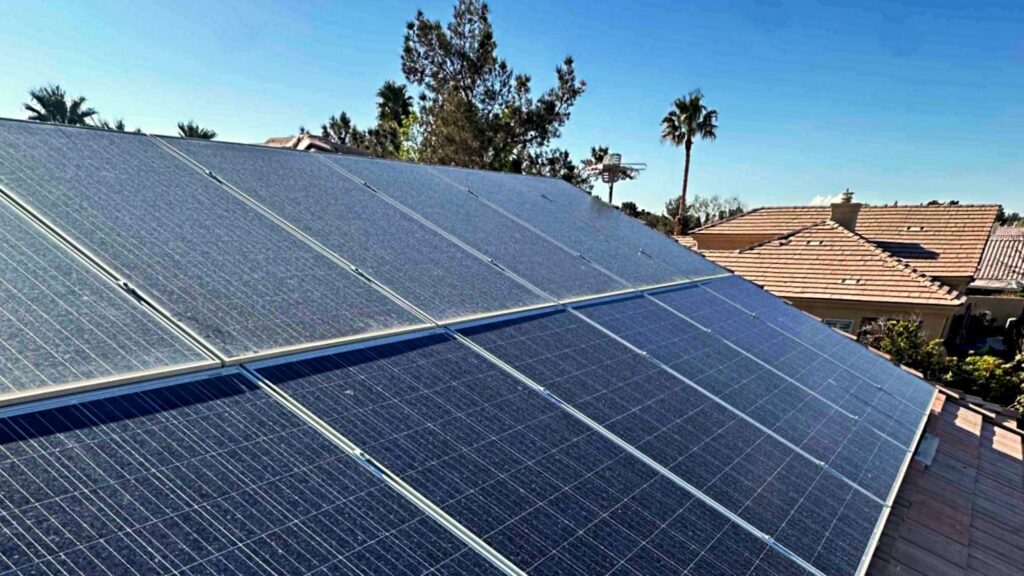
Indeed, the Las Vegas sun can provide solar energy to most homes based on the data provided by the National Renewable Energy Laboratory. However, solar panels work best when they have clear, unobstructed access to sunlight.
- How Much Space is Needed? As a general rule of thumb, This Old House suggests around 100 square feet of clear roof space per kilowatt (kW) of solar energy system. A typical residential solar panel might occupy about 15-20 square feet of usable surface area.
- Usable Space: In addition to total roof size, the space must also be clear of obstacles, like chimneys, skylights, vents, and satellite dishes.
- This is because these structures can cast shadows or take up valuable surface area.
- Las Vegas building codes often require specific setbacks, like 3-foot pathways from the eave of the ridge line for fire safety. The solar installer will account for.
- The Importance of Sunlight: The available space must be largely unshaded during peak sun hours, typically 9 a.m. to 3 p.m.
- A professional site assessment will include a detailed shading analysis to make sure your solar arrays will maximize the sun’s energy for optimal energy production and meet safety regulations.
5. Roof Orientation and Pitch (The Angle of Attack)
The angle and direction of your roof play a significant role in how much solar energy your panels can harness and enjoy the environmental benefits.
- Ideal Orientation: For maximum energy production in the Northern Hemisphere, south-facing roofs (180 degrees true orientation) are ideal. They receive the most direct sunlight throughout the day.
- Good Alternatives: East and west-facing roofs are also very effective in Las Vegas.
- East-facing panels capture strong morning sun.
- West-facing panels are excellent for afternoon energy production that can be beneficial for offsetting higher “time of use” rates from NV Energy.
- North-facing roofs are not recommended because they significantly reduce sunlight exposure.
- Pitch/Angle: There’s an optimal pitch, between 15 and 40 degrees in the continental U.S., aligning well with many residential roof slopes in Las Vegas. However, it’s less of a deal-breaker than orientation.
- Modern mounting systems and racking allow solar panels to be tilted to optimize their angle, even on flatter roofs, to capture more direct sunlight.
Is Your Roof Solar-Ready? Essential Pre-Installation Checklist
Ensure your Las Vegas home is prepared for solar installation with this comprehensive roof assessment guide.
Don’t Guess, Get an Expert Assessment!
Before you invest in solar, get a complete picture of your roof’s health and its readiness for the future of energy by checking out our solar panel installation guide. Contact Bob’s Repair Solar today for a free, no-obligation assessment from a team that specializes in both roofing and solar.

