
Every summer, our crews visit homes across the Las Vegas Valley and see the same thing: generic panels on stucco rooftops installed by companies that never factored in what a Nevada July actually does to solar equipment. When it’s 115°F at 3:00 PM, and the Mojave sun is driving roof surface temperatures past 150°F, the difference between the right panel and the wrong one shows up fast.
You don’t have to look at massive utility solar farms to know that Mojave Desert conditions are punishing. We see it firsthand on every service call. After replacing hundreds of heat-cracked inverters and sun-bleached wiring systems across Clark County, we know exactly what Southern Nevada’s extreme UV exposure and triple-digit heat do to a residential setup over time. Surviving here requires the right extreme-weather panels and a team that actually climbs Las Vegas roofs in July.
Since 2014, Bob’s Repair has been installing and servicing solar and HVAC systems across the Las Vegas Valley. This guide covers what that experience looks like on a Southern Nevada rooftop.
Why Las Vegas Desert Solar Panels Are Built for Arid Regions
The industry tests panels at 77°F (25°C). What our technicians read on a thermal gun pointed at a west-facing stucco roof in Summerlin at 2:00 PM in July is between 150°F and 180°F. Standard panels lose 0.34% to 0.50% of their rated output for every degree Celsius above that 25°C test baseline, and on a 115-degree Henderson afternoon, those losses compound every hour.
Temperature Uplift
Above Ambient
By Afternoon
According to the EPA, daytime temperatures in urban areas run 1–7°F higher than surrounding areas as hard surfaces absorb and re-emit solar heat. Conventional roofing materials can reach up to 66°F above ambient air temperatures. In North Las Vegas and Downtown, where older housing stock, deferred maintenance, and asphalt parking lots concentrate the problem, that puts roof surfaces well above 150°F before the afternoon is over. A panel flush against that surface with no airflow gets cooked from both sides.
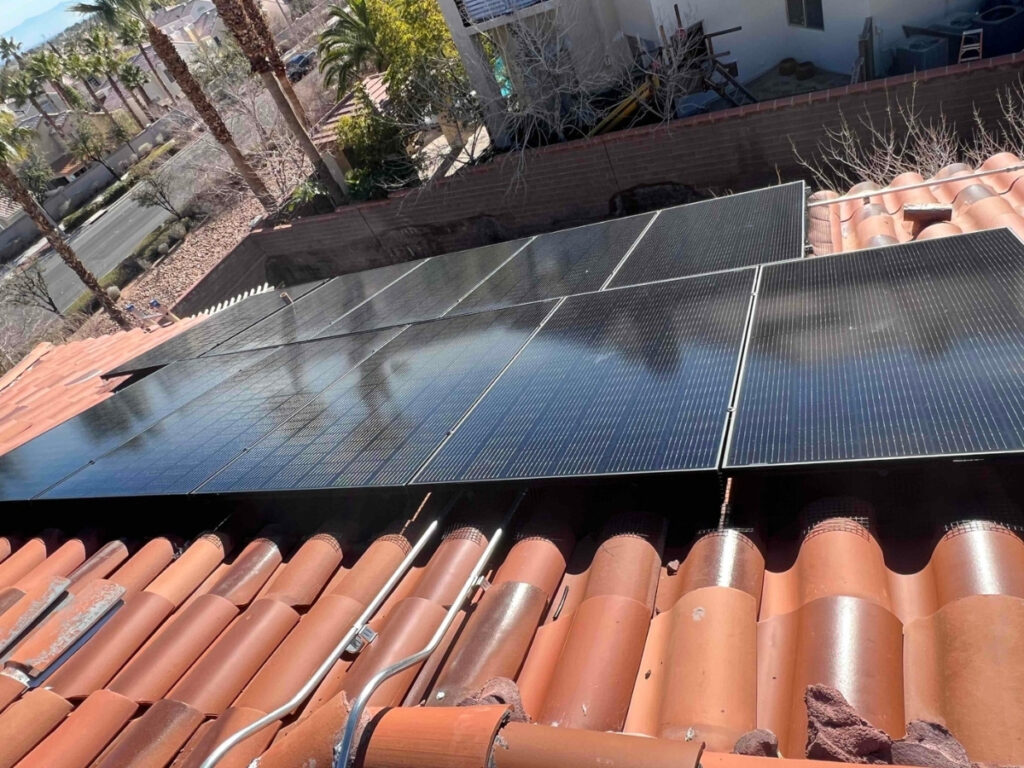
We install only Tier-1, heat-rated panels built for high-UV, extreme-temperature arid regions, mounted on elevated racking systems that maintain a gap between panel and roof deck. Thermal imaging research shows that the gap reduces the radiant heat reaching the roof deck by as much as 38%. That is what separates a panel that performs reliably in August from one that faults by 3:00 PM.
| Spec | Standard Residential Panel | Tier-1 Desert-Rated Panel |
|---|---|---|
| Test temperature | 77°F (25°C) | Rated for 150°F+ roof surface |
| Temp coefficient | 0.34–0.50% loss per degree Celsius above 25°C | Reduced degradation curve |
| Glass coating | Standard anti-reflective | Dust-resistant, scratch-rated |
| Racking | Often flush-mounted | Elevated gap for airflow |
| Warranty | 20–25 years | 20–25 years with desert rating |
How Solar Panels Act as a Heat Shield for Your Las Vegas Roof
When standard roofing materials bake in the afternoon sun, that heat radiates directly into your home. But properly mounted solar panels intercept that solar gain, creating a shaded airflow gap that cuts the surface temperature of your roof deck. The panels are not just generating electricity; they are actively shielding your attic from the brunt of the Mojave sun, applying the same principle of shade-cooling directly to your home
The same principle applies to your roof. Panels create shade, shade cuts surface temperature, and less radiant heat transfers into the attic below.
What we see consistently on properly installed systems in Anthem and Green Valley is that the measured attic temperature drop after panel installation outperforms what most homeowners expect from an insulation upgrade alone. The panels are not just generating power. They are physically blocking the Mojave sun from driving heat through your ceiling all afternoon. That baseline drop is why properly installed desert solar panels reduce your AC’s evening draw, and why the savings show up on the first NV Energy bill after installation.
Surviving Caliche Dust, Monsoons, and Desert Conditions
The Mojave isn’t just hot. It’s abrasive.
The white film on your car hood after an April haboob is caliche, an alkaline fine-particulate soil that coats every horizontal surface after a windstorm. On a solar panel, caliche accumulation blocks 10% to 25% or more of incoming sunlight. High-speed sand scratches glass coatings that are not rated for desert conditions, and that damage is permanent.
Our standard is professional cleaning three to four times a year using deionized water. Las Vegas tap water carries significant mineral content and leaves deposits as it evaporates. August monsoon downpours are not a free cleaning cycle. The rain picks up caliche from surrounding surfaces and deposits mineral-rich runoff on the glass. What dries there is harder to remove than the original dust.
The panels we install use anti-reflective, dust-resistant glass engineered for arid regions. Las Vegas temperature swings of 40 degrees or more between afternoon peak and midnight stress wiring connections and accelerate aging in inverters and batteries. Every Bob’s Repair installation accounts for that thermal expansion, and every system is permitted and inspected to Clark County wind and seismic compliance standards before sign-off.
How Bob’s Repair Handles Desert Solar Installations
Most solar companies in Las Vegas are not HVAC companies. They install panels and hand you off when your air conditioner starts struggling. In a desert climate that misses the whole point, because the primary job of a solar system on a Southern Nevada home is offsetting the power your AC burns.
We handle both. As a Tesla Energy-certified solar installer and authorized Trane dealer, every installation is performed by NATE-certified technicians working in the Las Vegas Valley year-round, not flown in for a seasonal rush. All work comes with a 100% satisfaction guarantee, a 5-year labor warranty, a 10-year parts warranty, and no hidden costs. We are available seven days a week, with 24/7 emergency service, because a system failure at 11:00 PM on a 105-degree night cannot wait until Monday.
With 3,100+ five-star reviews and a 4.9 on Google, the track record stands on its own.
“I had Bob’s Repair Solar install 73 solar panels with Enphase Microinverters. They made the process easy and delivered on time. The reason I chose them because they did all the work and didn’t sub anything out. If you need a solid company these are the people you need to call.”
How Desert Solar Panels Power Your Las Vegas HVAC System
Solar’s primary job on a desert home is not lighting. It’s cooling.
The failure pattern our technicians see repeatedly: an aging rooftop package unit on an older Henderson home runs at full load all afternoon with no solar offsetting the draw. The attic hits 140°F by 2:00 PM. By 11:00 PM on a 105-degree night, the unit quits. Many homeowners in Summerlin and Henderson delay solar over HOA concerns first, but Nevada law limits what an HOA can actually do to block a solar installation.
When the solar array and AC unit are correctly sized and integrated, that failure does not happen. Solar generation reduces the draw at peak rates. A shaded roof cuts the heat entering the attic. A properly sized AC system never has to run at 100% capacity just to hold temperature. If your current setup is showing strain before peak season, starting with a full solar and HVAC system review is the right move before the May heat arrives.
Do You Need Battery Storage in Southern Nevada?
Do You Need Battery Storage in Southern Nevada?
NV Energy’s Time-of-Use on-peak window runs from exactly 6:01 PM to 9:00 PM daily between June 1 and September 30. The sun is dropping by then, but Las Vegas air temperatures commonly sit above 95°F well past midnight. Battery storage captures what the system generates during peak solar hours and deploys it during those expensive evening hours. Qualified installations may also be eligible for active NV Energy rebate programs, which our team walks through during every free assessment. If storage is part of your design, how utility approval works in Nevada will directly affect your installation timeline and net metering calculations.
Stop Letting the Mojave Sun Run Up Your NV Energy Bill
Schedule a free home solar and HVAC assessment with Bob’s Repair, or call us directly at (702) 381-5080. Same-day service available seven days a week across the entire Las Vegas Valley.
NV Energy’s Time-of-Use on-peak window runs from exactly 6:01 PM to 9:00 PM daily between June 1 and September 30. The sun is dropping by then, but Las Vegas air temperatures commonly sit above 95°F well past midnight. Battery storage captures what the system generates during peak solar hours and deploys it during those expensive evening hours. Qualified installations may also be eligible for active NV Energy rebate programs, which our team walks through during every free assessment. If storage is part of your design, how utility approval works in Nevada will directly affect your installation timeline and net metering calculations.
Stop letting the Mojave sun run up your NV Energy bill. Schedule a free home solar and HVAC assessment with Bob’s Repair, or call us directly at (702) 381-5080. Same-day service available seven days a week across the entire Las Vegas Valley.

