
Most people researching off-grid solar don’t actually want to disconnect from the utility company. They want backup power during outages and lower electricity bills. Understanding this distinction could save you $30,000 or more.
True off-grid solar means complete independence from your utility provider. Your solar array, batteries, and inverter handle everything. Grid-tied systems with battery backup maintain your utility connection while storing solar energy for emergencies. For Las Vegas homes, the second option delivers superior reliability at half the cost.
This guide explains off-grid solar mechanics, then reveals why a hybrid approach works better for most residential properties.
What Off-Grid Solar Actually Means

Off-grid solar systems function independently from utility companies. Your home runs exclusively on solar energy stored in batteries. When darkness arrives or clouds appear, your battery bank supplies electricity until sunshine returns.
These systems excel for remote cabins, RVs, or properties where utility connection costs exceed solar installation expenses. But for occupied homes with modern appliances—particularly in hot climates—the required battery capacity becomes financially impractical.
Grid-tied systems with battery backup connect to your utility while storing excess solar production. You draw from the grid when necessary and export surplus power for credits. Your batteries activate only during outages, requiring far fewer units.
Essential Components of Off-Grid Solar
Understanding system mechanics clarifies why they’re complex and expensive for residential use.
Solar Panels: Your Primary Power Source
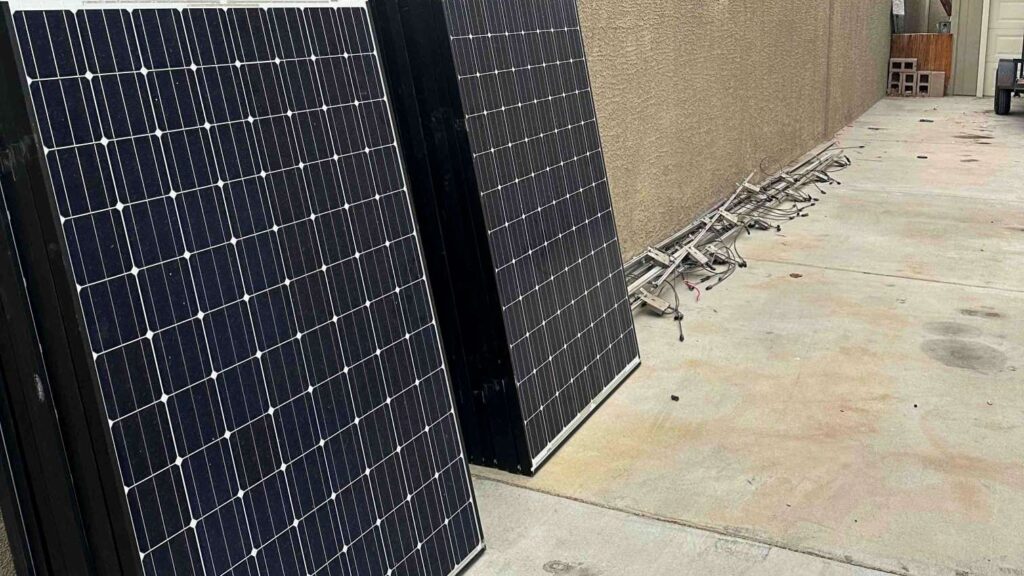
Solar panels transform direct sunlight into DC electricity. Power generation depends on panel wattage, available sunlight hours, and weather conditions. Las Vegas enjoys approximately 294 sunny days annually, which appears ideal—but cloudy weather still reduces output.
According to the U.S. Department of Energy’s National Renewable Energy Laboratory, residential solar system costs have declined to $2.68/WDC in 2023, representing significant cost reductions over the past decade. However, off-grid systems still require substantial battery capacity that drives up total costs.
Panel placement matters significantly. South-facing roofs with minimal shade produce maximum energy. Installing panels on a scorching Vegas roof in July presents serious challenges—asphalt shingles reach 160°F, and metal mounting hardware becomes dangerously hot.
Solar Charge Controller: The Critical Gatekeeper
The charge controller sits between your solar array and battery bank. It prevents overcharging, which destroys batteries and creates fire hazards. Two types exist:
PWM Controllers
PWM controllers work for smaller setups. They cost less but deliver reduced efficiency, essentially discarding excess power.
MPPT Controllers
MPPT controllers cost more but extract 20-30% additional energy from panels. For larger systems, this efficiency improvement justifies the investment within several years.
Without proper charge controller sizing, your expensive battery bank degrades rapidly. This component regulates voltage and ensures safe energy storage and charging.
Battery Bank: Where Energy Lives
Battery capacity determines appliance runtime without sunlight. Most off-grid homes require 10-20 kWh minimum storage, but homes with central AC can demand 50+ kWh for hot summer nights.
The U.S. Department of Energy’s Solar Energy Technologies Office tracks residential energy storage costs and notes that battery technology continues to improve. According to their 2024 benchmarks, integrated solar-plus-storage systems are becoming more accessible, though off-grid applications still require significantly larger battery banks than grid-tied backup systems.
The reality:
A 3-ton AC unit typically consumes 3-3.5 kW continuously during operation, with startup surges reaching 5-7 kW. Running it for five hours nightly alone consumes roughly 15-17.5 kWh. You’d need multiple batteries just for cooling, before accounting for lights, refrigerators, and other devices.
Off-Grid Inverter: Converting DC to Usable AC Power
Batteries store DC electricity, but homes run on alternating current. The inverter enables this conversion. Off-grid systems require pure sine wave inverters—modified sine wave models damage sensitive electronics and create annoying buzzing in audio equipment.
Your inverter must handle peak power demands plus a safety margin. If your AC unit draws 3,500 watts at startup with surges up to 7,000 watts, your inverter needs at least 8,000-watt capacity to prevent overload shutdowns.
How Many Solar Panels Do You Actually Need?
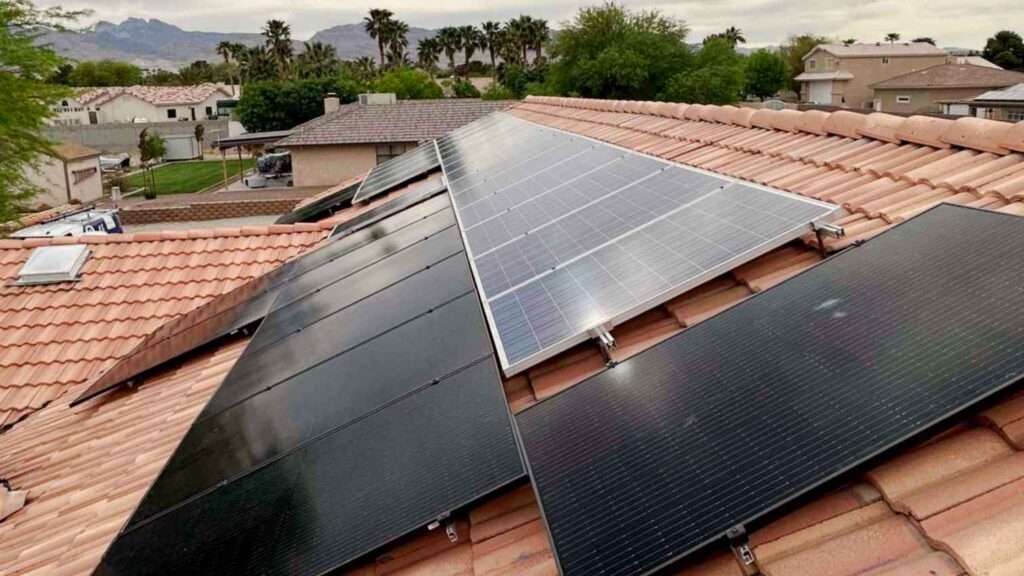
The answer depends on power usage, battery capacity, and available roof space.
The U.S. Energy Information Administration reports that the average U.S. household consumes about 10,500 kilowatt hours per year, though consumption varies significantly by region and climate. Homes in hot climates like Las Vegas typically exceed this average due to air conditioning demands, with most Las Vegas homes consuming 25-35 kWh daily.
Lead-Acid Batteries
Lead-acid batteries cost less initially but last 3-5 years and require maintenance. They also need ventilation due to hydrogen gas production during charging.
Lithium-Ion Batteries
Lithium-ion batteries cost double but last 10-15 years, need zero maintenance, and provide greater usable capacity. They’re standard for modern systems.
The cost? Based on 2024-2025 pricing, a complete off-grid system requiring 40-60 kWh of battery storage (3-4 Tesla Powerwalls at $13,500-$15,400 each), plus 20-30 solar panels, charge controllers, and inverters typically costs $50,000-$80,000 or more before incentives, and before the backup generator you’ll eventually need.
The Las Vegas Reality Check
Las Vegas presents unique challenges for true off-grid living. Summer temperatures hit 110°F regularly. AC runs constantly. A single day without solar production (from dust storms or equipment failure) means no cooling—potentially dangerous for families with elderly members or health conditions.
While small off-grid kits can run essential devices, they often cannot power full homes in Las Vegas, especially when air conditioning and other high-demand appliances are required.
The AC Problem
Central air conditioning is the issue that off-grid solar calculators often ignore. A 3-ton AC unit typically consumes 3-3.5 kW continuously during operation, with startup surges reaching 5-7 kW.
This distinction matters for off-grid systems because frequent starts/stops increase energy consumption. Over a 10-hour cooling period, that’s 30-35 kWh—exceeding your entire daily power budget.
Going truly off-grid in Vegas means either:
- Installing $60,000+ in batteries to run AC comfortably
- Living without AC on hot days
- Running a noisy, polluting backup generator regularly
None appeals to most homeowners.
Grid-Tied Solar with Battery Backup: The Superior Solution
Grid-tied systems let you produce solar power while staying connected to NV Energy. When panels generate more electricity than you use, excess flows to the grid and earns credits. When you need more power than panels produce, you draw from the grid.
Adding battery backup provides blackout protection without massive battery banks required for off-grid setups.
Three Key Advantages
Net metering credits reduce bills
Your meter runs backward when producing excess solar power. On sunny spring days, you might generate 45 kWh but only use 20 kWh. Those 25 extra kWh become credits offsetting usage on hot summer nights.
Batteries handle outages, not daily operations
Your battery only activates when the grid fails. A single 13.5 kWh battery keeps essential circuits running 8-12 hours—enough to ride out most Vegas outages comfortably. You don’t need storage to power your entire home indefinitely.
You use the grid as your virtual battery
Instead of storing every kilowatt-hour you generate (requiring expensive batteries), you export surplus power and import it back when needed. The utility company essentially stores your energy at no cost.
Comparing Systems
When choosing a home energy upgrade, it helps to compare system types side by side to see cost, storage, and performance differences.
| System Type | Key Features | Notes |
|---|---|---|
| True Off-Grid | Initial Cost: $50,000–$80,000 Battery Storage: 40–60 kWh Can Run AC Freely: No | No net metering, high maintenance |
| Grid-Tied + Battery | Initial Cost: $30,000–$40,000* Battery Storage: 10–15 kWh Can Run AC Freely: Yes | Net metering available, moderate maintenance |
*Costs based on NREL 2023-2024 residential solar benchmarks at $2.68/WDC plus battery storage
Overall, a grid-tied system offers a more affordable home energy upgrade with reliable power and rebate eligibility while still supporting high-efficiency electric appliances.
What About Off-Grid Solar Kits?
Small off-grid solar kits work great for specific applications:
- Powering a remote cabin with minimal electrical needs
- Running lights and small devices in an RV
- Backup power for essential circuits during camping trips
These kits typically include a few panels, a basic charge controller, a small battery, and an inverter. They’re genuine DIY projects requiring only basic electrical knowledge and copper wire connections.
But they won’t power full homes. The 2,000-watt systems advertised as “whole-home backup” barely run a microwave and fridge simultaneously, let alone AC, water heaters, and other major appliances.
Professional Installation vs. DIY

Installing an off-grid cabin setup yourself? Absolutely doable if comfortable with electrical systems and can follow wiring diagrams carefully. Many manufacturers provide detailed schematics showing connections.
Installing whole-home grid-tied systems with battery backup? That requires licensed contractors. Reasons include:
- Interconnection agreements with utilities require professional engineering plans
- Electrical permits mandate a licensed electrician to work on systems over 1,000 watts
- Roof warranties are often void if unlicensed installers cause damage
- Safety codes require precise wire sizing, grounding, and surge protection that DIY installers commonly miss
Poorly wired solar installations cause fires, electrocution, or equipment damage. Professional installation includes insurance, warranties, and peace of mind that your system meets code.
Start Small, Scale Smart
If drawn to energy independence, consider this approach:
Install grid-tied solar without batteries. You’ll see immediate bill savings and learn how much power panels actually produce across seasons.
Add battery backup once you understand usage patterns. You’ll know exactly how much storage you need instead of guessing.
Expand your system as the budget allows. Modern equipment makes adding panels and batteries straightforward.
This staged approach costs less upfront and prevents oversizing (or undersizing) your system.
The Bottom Line: Energy Independence Without Compromise
Setting up solar panels to charge an off-grid home involves solar panels, charge controllers, battery banks, and inverters working together. The process is technically straightforward but financially impractical for most primary residences—especially in hot climates where AC dominates energy needs.
Grid-tied systems with battery backup deliver true energy independence without forcing you to choose between comfort and sustainability. You get backup power during outages, reduced utility bills through net metering, and the ability to run power-hungry appliances without anxiety.
For Las Vegas homeowners, this hybrid approach provides reliability, cost savings, and peace of mind that pure off-grid systems can’t match. Setting up solar panels to charge an off-grid home can seem overwhelming, but the right guidance from Bob’s Repair makes the process much simpler and more reliable.
Want backup power without sacrificing your AC or doubling your solar investment?
Contact Bob’s Repair to design a grid-tied solar system with battery backup that gives you the best of both worlds.

